One piece of music per style
How we write the brief for a series' original music, and why a social network's music library is not enough.
7 October 2026 · music · VARENNE · brief
The problem
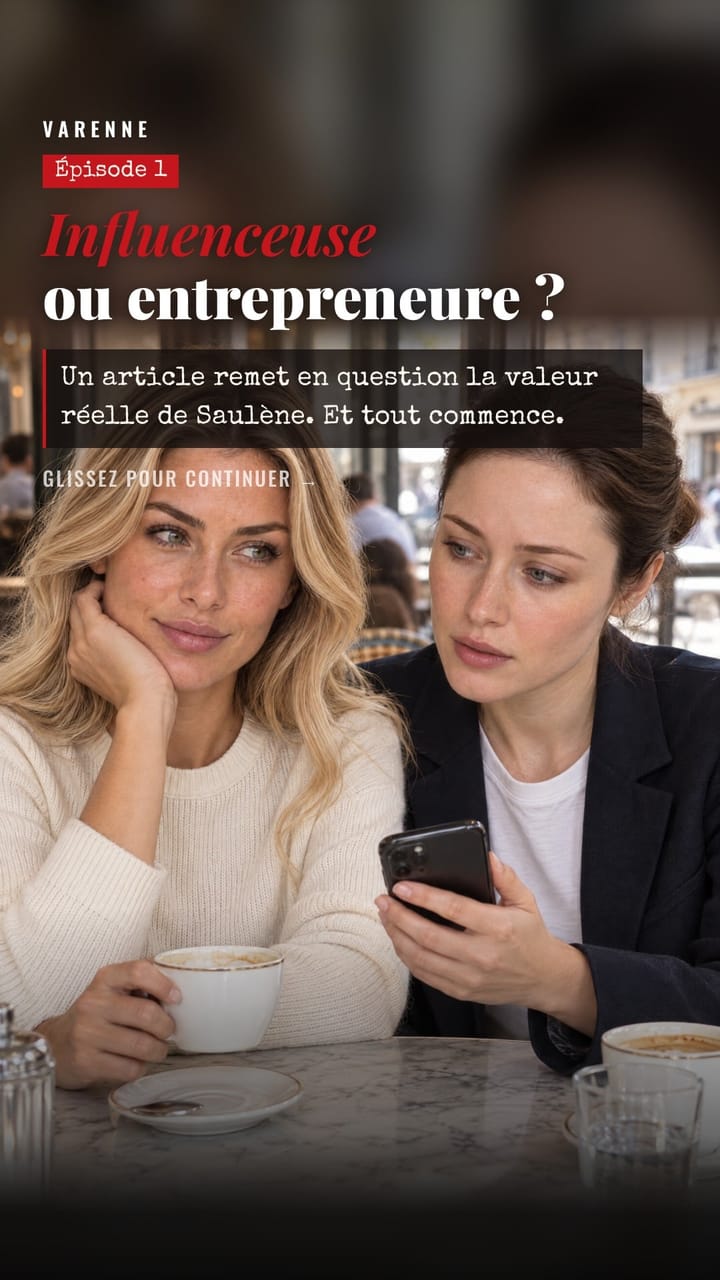
VARENNE was released on Instagram with a track from the network’s music library. It is convenient, and it is a trap: that licence only covers that network. The same episode, placed on a website, on another platform or in a scheduling tool, no longer has the right to its music. A series therefore needs a theme of its own.
A brief, not a prompt
We wrote the brief the way we would write it to a composer, in five sections, one line each:
- Context: the musical family, the era, the use. Here, a hushed late-1980s soul, meant as a series theme and as a reading background.
- Instrumental: the tempo, and two or three named instruments. A round bass, soft congas, a warm electric piano, a tenor saxophone that answers.
- Voice: the register and the manner. A low female voice, close to the microphone, restrained, almost spoken.
- Structure: the order of the parts and what returns. The groove from the first bar, a flat arc, the saxophone after each chorus.
- Production: the mix and the mood. A warm analogue mix, a spacious reverb, a Paris night.
Alongside it, a short list of what we do not want: pitch-corrected vocals, trap drums, club synths, distorted guitars, gospel choirs. Exclusions avoid more bad takes than adjectives do.
The lyrics
They are written in English, on purpose. The episodes are read, in French, balloon by balloon; a voice singing in the same language as the balloons fights them. In English, it becomes a texture. The text picks up the series’ theme, what is hidden behind a composed face, without ever naming a character.
Judging the takes
An episode lasts one minute. So a take is judged on its first minute only: the intro, the first verse, the chorus. Takes where the voice comes in too late, or too early, are discarded. We also keep an instrumental take with the same brief, for passages where the balloons are dense.
Two rules that are not up for discussion. The commercial licence depends on the subscription active at generation time: we note it for every track. And a take that resembles an existing song is discarded, however good: the brief targets a musical family, not a title.
The edit
The track is placed at the start of each episode, at a moderate level, below that of a trailer, since the episode is read. The chorus ends just before the end card, and the saxophone fades in over “To be continued”. The same theme for all twelve episodes: it is the title music.